

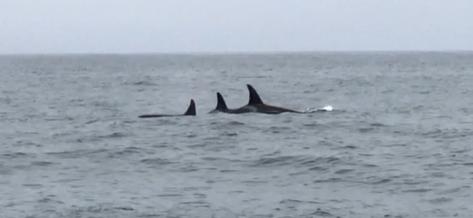
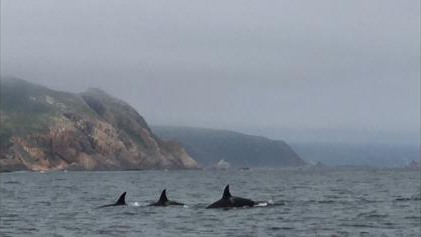
On Saturday, a few lucky boaters outside Knysna enjoyed a rare encounter when a pod of Orcas graced the waters with their magnificent presence. The sighting took place about half a mile south of the Knysna Heads.
While the waters off the Western Cape are known for their whale watching potential, dolphins, orcas and many other sea-bound mammals also roam these waters.
Orcas, also called killer whales, are not a frequent sighting in Knysna. Although they are year-round residents on our Southern African coastline, they are quite shy and not easily spotted in the wild.
Despite being called killer whales, Orcas are in fact the largest member of the oceanic dolphin family. These strikingly beautiful mammals are well-known for their tall dorsal fins – those of males grow up to two metres (6.5 feet) long – and characteristic black and white colour patterns. This patterning works like camouflage, from above and below. It breaks up their appearance and makes them harder to see in the water.
The nickname “killer whales” comes from Spanish sailors who travelled vast distances across the oceans and who had often been witness to the Orca’s deadly hunting skills. They named them ‘Matador de Ballenas’. This term is directly translated as ‘killer of whales’. Their scientific name comes from the mythical Orcus — the Roman god of death and the underworld. Employing teeth that can be ten centimetres (four inches) long, they feast on a variety of marine mammals such as seals, sea lions, and even small whales. They also snack on fish and sea birds.

Orcas live in family pods that can contain four generations and up to 40 individuals. Calves stay by their mothers’ sides until they become adults. Juveniles can swim from the moment they are born, but they are totally dependent on their mothers’ milk for a year or two.
Orcas are highly intelligent, social mammals, and to be a successful member of the pod they need to master a huge range of skills: hunting tactics, social interaction, knowledge of feeding and breeding grounds, and migration routes. The eldest female is in charge, telling the group when and where to feed. Adult members of the pod teach the young these essential life skills, and one day they will pass on these skills to their own children. Orcas make a wide variety of communicative sounds, and each pod has distinctive noises that its members will recognize even at a distance.
Though they are powerful hunters and are known to exhibit somewhat tortuous behaviour towards large sharks and other marine mammals, there is no record of a killer whale ever attacking a human in the wild.
As sightings of Orcas remain rare and unpredictable, recordings and images of pods of killer whales are a fantastic memory to capture.
Interesting Facts About Orcas
- Orcas are the largest members of the dolphin family, growing up to 9.8 metres (32 feet) in length and ten metric tons (22,000 pounds) in weight.
- Killer whales are the most widely distributed mammals in the world (not counting humans).
- Female orcas are one of only three species that go through menopause, the other two being short-finned pilot whales and humans.
- Orcas sleep with just one half of their brain at a time. They need to remain semi-awake all the time, so they can surface to breathe.
- Orcas have the second-biggest brains among all ocean mammals, weighing as much as seven kilograms (15 pounds).
- The oldest known killer whale lived to be 103.
Ocean Odyssey is Knysna’s only permitted close encounter whale-watching operation and has been awarded the prestigious Blue Flag Status, an international award given to beaches, marinas and nature-based boat excursions that meet excellent standards in the categories of environmental education, environmental management, safety and security and water quality.